Dental technology is evolving fast, and soft-tissue lasers are at the forefront of that change. These devices use a highly focused beam of light to trim, shape, or remove gum and other soft tissue much like a “laser scalpel”.
Imagine a tiny, precise flashlight that can cut tissue and seal blood vessels at the same time. The laser’s light energy is targeted so accurately that it only affects the treated area, leaving healthy tissue unharmed. For patients, this means less pain, less bleeding, and a faster healing process than with traditional scalpels or drills.
Dr. Nidhi, a dentist with SR Dental Implants & Braces Centre, highlights how these lasers can make many treatments smoother and more comfortable. She emphasizes that procedures which once caused anxiety—like frenectomies (tongue-tie releases), teeth whitening, or root canals—become much easier when a laser is used. In her experience, lasers are especially beneficial for treating tongue-tie in children, enhancing in-office teeth whitening, and improving root canal therapy.
How Do Dental Lasers Work?
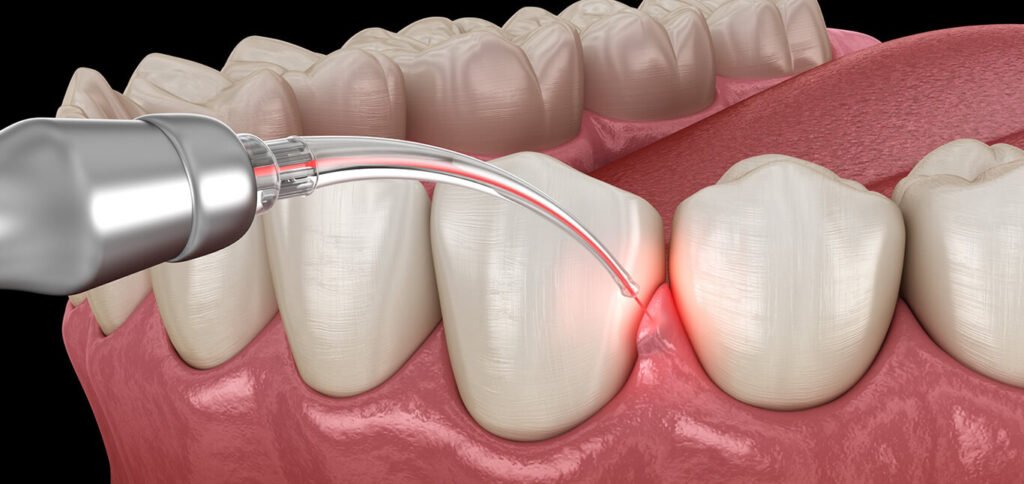
A soft-tissue dental laser emits a concentrated light beam at a specific wavelength that is absorbed by water and blood in the gums and soft tissues. When this light hits the tissue, it creates intense but localized heat. This does two things at once:
- Precision cutting: The laser vaporizes or “evaporates” tiny amounts of tissue exactly where the dentist points it, almost like a sculptor with a beam of light. It’s as if you could trim an overgrown plant with a sharp laser beam instead of garden shears, removing only the parts you want to remove.
- Instant cauterizing: At the same time, the heat seals small blood vessels and nerve endings on contact. This is like using a heated soldering iron instead of scissors – it cuts and cauterizes simultaneously. The result is minimal bleeding and often much less discomfort.
In practice, using a laser for gums or other soft tissue can be more like feeling a warm pinpoint of heat rather than the rough tugging of a scalpel. Many patients describe it as a light tingling sensation. Because the beam “seals as it cuts,” lasers often eliminate the need for stitches or packing, and help tissue heal more quickly.
Dentists carefully adjust the laser settings for each procedure. The device might feel a bit like a high-tech pen held at the tip of a pencil – as your dentist guides it along your gums, it can remove tissue millimeter by millimeter. Protective eyewear keeps everyone safe, but modern dental lasers are FDA-approved and very precise.
General Advantages of Soft-Tissue Lasers
Switching from a scalpel to a laser in your mouth brings many perks. Both research and dental experts agree on the big benefits of laser dentistry:
- Less pain and anxiety. Lasers reduce or often eliminate pain. They seal nerve endings as they work, which numbs the area naturally. Many patients find they don’t even need a shot of local anesthesia for minor laser procedures. This makes procedures feel more like a quick pinch or warm touch instead of deep drilling or cutting. Fewer needles and less pain mean less fear for anxious patients.
- Minimal bleeding. Because the laser cauterizes, there’s almost no bleeding during or after the procedure. This not only keeps the treatment area cleaner but means a faster recovery. You’ll often see the gums staying “neatly sealed,” which helps the healing process.
- Faster healing. With less trauma to tissue, your body can repair itself more quickly. Lasers stimulate tissue regeneration and reduce inflammation, so swelling and soreness are usually milder. Many people notice they can return to normal eating and talking in a day or two, much sooner than after traditional surgery.
- Lower infection risk. The laser’s high-energy light actually sterilizes the area it touches. It kills bacteria on contact, so the chance of post-treatment infection drops. This is especially reassuring when treating open wounds, deep gum pockets, or root canals.
- No or fewer stitches. Because the laser seals blood vessels, stitches (sutures) are often unnecessary. This means no stitch removal later, and the treated area stays more comfortable as it heals.
- Greater precision. Dentists can shape and remove tissue with high accuracy, only where it’s needed. Think of it like using a fine-tipped paintbrush instead of a broad roller. If you have uneven or “gummy” gums, the laser can sculpt them very finely. In cosmetic cases, this precision produces very natural results.
- Tissue preservation. Even in cavity treatment, lasers can remove decayed parts while preserving healthy tooth structure. For soft-tissue work, the precision means only unnecessary tissue is trimmed – healthy gums and other tissues stay intact as much as possible.
Patient Tip: Many dentists report that patients feel less anxiety knowing a laser is used instead of drills or scalpels. You might hear a gentle whir or click, but no loud buzzing. Often, explaining the benefits of the laser itself can help patients relax before treatment.
Gum Contouring and Reshaping
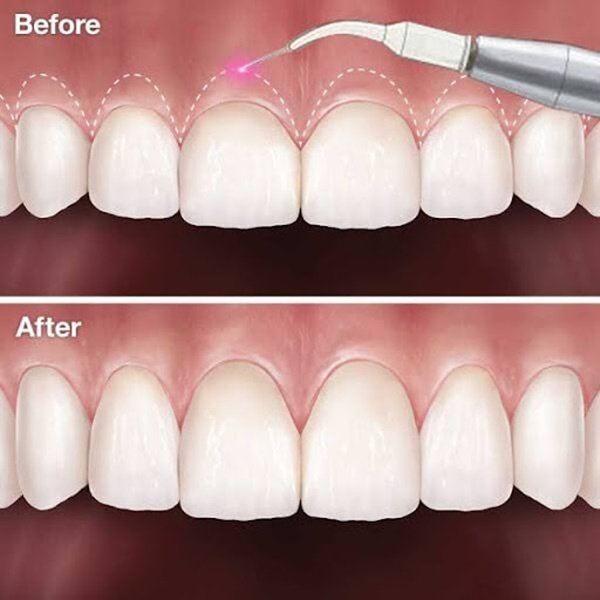
One common use of soft-tissue lasers is gum contouring, also called gum reshaping or gingivoplasty. This is often done to treat a “gummy smile” or to even out the gum line for a nicer smile.
With traditional surgery, the dentist might cut away excess gum with a scalpel. That approach works, but it usually means more bleeding, stitches, and discomfort during recovery. By contrast, laser gum contouring is much gentler. The laser beam can precisely remove tiny strips of gum tissue to expose more tooth surface.
Patients experience several benefits: there’s minimal bleeding because the laser seals as it cuts, and the gum line can be made very even and natural-looking. As one dentist describes it, the laser allows more “accurate shaping of the gum line” with “less postoperative pain and swelling”. In fact, many people are surprised at how quickly they heal — often in a day or two they can eat and speak normally.
Dr. Nidhi notes that for patients wanting a more symmetrical smile, lasers give “impressive results” with far less fuss. The precision means she can tailor the gum shape to each person’s smile, almost like an artist sculpting clay. And because the laser sterilizes the site as it works, infection risk is lower – another comfort factor.
Analogy: Think of gum contouring like trimming hedges with a laser hedge-trimmer instead of hand shears. The laser tool lets the “gardener” snip exactly where needed and seals the cut edges instantly, so the “garden” looks neat without a mess.
Gum Depigmentation (Gum Bleaching)
Some people have dark or uneven gum coloring (from genetics, smoking, or other factors) and wish to lighten it for purely cosmetic reasons. Soft-tissue lasers make gum depigmentation (also called gum bleaching) quick and painless.
The dentist uses a laser to vaporize the thin top layer of gum tissue where the dark pigment resides. It’s a bit like carefully erasing a marker stain on cloth: the laser “burns away” the dark cells, revealing the pink healthy gum underneath. This technique is very precise and bloodless. According to specialists, it is “one of the most effective” treatments with “better aesthetic outcomes and a low recurrence rate”.
Importantly, patients tolerate it well. The laser’s intense pulses mean the procedure is quick and comfortable. For example, clinics using the FDA-approved Waterlase system report that gum depigmentation is often done without any local anesthetic, thanks to minimal pain and bleeding. They describe it as “quick, precise, safe, and gentle, with minimal bleeding”. Many patients are pleasantly surprised to see their gums lighten immediately with hardly any downtime, sometimes without even feeling sore afterward.
Benefit: Laser gum bleaching typically means a faster recovery and less discomfort than cutting and grafting methods. The area sterilizes itself by the laser, and you’ll usually go home with just a little tenderness, not a throbbing wound.
Tongue-Tie Release (Frenectomy)
A tongue-tie (ankyloglossia) is when a tight band of tissue (the frenulum) tethers the tongue to the floor of the mouth. Releasing it (a frenectomy) lets the tongue move freely, which can help babies feed and children speak better. Dr. Nidhi sees many cases in her practice and often recommends a laser for this procedure.
Why lasers for tongue-ties? Because they make the procedure extremely fast and easy. With a surgical knife, there would be more bleeding and usually stitches. With a laser, it’s almost a blur of light. In fact, pediatric dentists report that a laser frenectomy can take only 2–3 minutes. The laser beam quickly “severs” the tight tissue and the heat seals the tiny blood vessels immediately. This means virtually no bleeding and no need for sutures.
For the patient – especially a squirmy baby or fearful toddler – this is a huge advantage. The laser procedure usually feels like a brief warm touch. Parents often report their child hardly cries or recovers much faster. According to one pediatric practice, because the laser already closes off vessels, “healing is already a step ahead” and the recovery is much quicker. Pain and swelling after a laser frenectomy are minimal compared to the old way.
Dr. Nidhi points out that for infants, a laser frenectomy often doesn’t even require general anesthesia – sometimes just topical numbing. In her words, “we can free a tongue tie with hardly a drop of blood and no stitches,” making life better for little ones (and their parents).
Patient-Friendly Analogy: Imagine a hot knife gliding through butter. The laser cuts and seals at once, so it’s quick, neat, and there’s almost no “bleeding.” It’s similar to using a cauterizing scalpel in surgery – precise and efficient. Parents often say, “We blinked, and it was done.”
Teeth Whitening
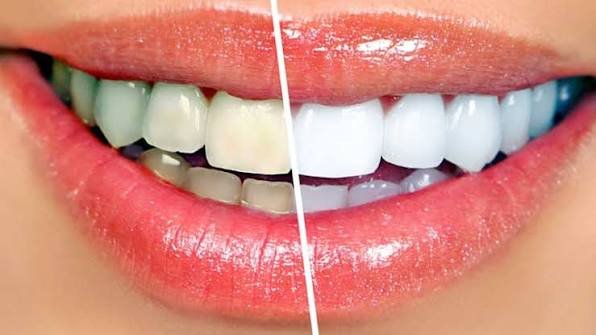
Laser technology can also speed up teeth whitening treatments. Typically, whitening involves applying a peroxide gel to the teeth. A laser beam (or bright light) is then used to activate this gel, accelerating the whitening reaction. In simple terms, the laser gives the whitening gel a quick jolt of energy, breaking stains apart faster.
The advantage is efficiency and brightness. Clinical data show that laser-whitened teeth can become several shades lighter in just one office visit. The laser’s high energy causes the peroxide to release more oxygen ions, which break down pigment more effectively. As a result, patients often see noticeable results in a short time, much quicker than without a laser.
Another benefit is reduced sensitivity. Some lasers are designed to control the temperature of the gel, so it doesn’t overheat the tooth. By carefully tuning the light’s wavelength, lasers can even dampen nerve inflammation in the tooth, meaning many patients experience less post-whitening sensitivity.
Dr. Nidhi notes that using lasers for whitening can make a big difference for busy patients who want brightening in a single visit. The laser-handpiece is like a focused “boost” to the bleaching process – it’s as if you’re watching your dentist shine a high-powered flashlight on your teeth to make the whitening gel work harder. Because of this, “the whitening effect is typically more pronounced and long-lasting” compared to traditional methods. Patients often walk out amazed at how white their smile became by the end of one appointment.
Root Canal Therapy
Root canals have a reputation for being lengthy and uncomfortable, but lasers are helping change that too. In endodontic (root canal) treatment, the goal is to remove infected pulp tissue from inside a tooth. Lasers can assist in several ways.
First, bacterial disinfection: The laser’s light energy can penetrate into the tiny crevices of the root canal system, killing bacteria more thoroughly than chemical disinfectants alone. According to the American Dental Association, lasers are used in root canal work to “remove bacteria during root canal procedures”. Dr. Nidhi explains that she uses lasers to zap any lingering germs deep in the canal, giving a much cleaner end result.
Second, shaping and cleaning: Some lasers (like Waterlase) can also physically clean the inside of the canal. The dentist uses a special laser tip to essentially “sandblast” the canal walls. This means they can remove debris and shape the canal while directly observing the process. As one laser manufacturer notes, lasers are indicated for “cleaning and shaping of root canals” and for final disinfection. Patients benefit because the tooth can often be sealed and filled in fewer visits.
Finally, comfort: Laser root canals tend to be gentler on the patient. Since the laser doesn’t vibrate like a drill and often requires less pressure, many patients report a more comfortable experience with less pain during and after. The laser’s precision also spares healthy tissue, and the lack of mechanical scraping means many post-op soreness is avoided.
By combining traditional techniques with lasers, Dr. Nidhi finds that root canal treatments are more successful and recovery is smoother. The focused laser beam targets only diseased tissue or bacteria, leaving healthy tooth structure alone. As a result, patients usually need fewer repeat visits and have faster healing, which is especially welcome after a “salvage” procedure like a root canal.
Other Applications
Soft-tissue lasers have many other uses too. Dentists use them to:
- Treat gum disease: Lasers can remove infected gum tissue deep around the teeth, helping the gums reattach to the tooth more quickly.
- Remove lesions or biopsies: Thrush, cold sores, and small growths can be vaporized easily with a laser.
- Snoring/tongue-tissue treatments: Specialized lasers (like those for snoring) can tighten throat tissues.
- Lip-tie releases: Similar to tongue-tie, a tight lip frenulum can be released with the laser, reducing breastfeeding difficulties in infants.
In each case, the benefits are the same: precision, comfort, and speed. Lasers can often do the same work as a scalpel with far less fuss.
Why Dr. Nidhi Recommends Lasers
Dr. Nidhi has seen the impact of lasers firsthand. From her perspective, the big win is patient comfort. She often tells patients, “Lasers make dentistry feel more like spa care than surgery.” For example, she points out that a child needing a frenectomy will have a very quick, gentle experience under the laser (often with just a sweet-tasting gel for numbing) instead of a scary knife. Parents also appreciate knowing there will be less bleeding and no stitches.
In cosmetic treatments, Dr. Nidhi notes that lasers give predictable, beautiful results. Teeth whitening sessions finish much faster, and gum reshaping looks more natural because the doctor can “paint” the new gum line with light. Patients leave smiling sooner and with less downtime.
For root canals, she emphasizes that lasers help save natural teeth that otherwise might have needed extraction. By eliminating bacteria better, there’s a higher chance the tooth stays healthy long-term. This aligns with her focus on endodontics and single-visit root canals.
Overall, Dr. Nidhi tells patients that lasers are an excellent tool in modern dentistry. She believes any clinic using lasers with skilled dentists is offering a gentler approach to many procedures. Her advice: if your child or you need a tongue-tie correction, teeth whitening, or a root canal, ask about the laser option. In many cases, it means a more comfortable procedure and quicker recovery.
Practical Advice for Patients
If you’re considering laser-assisted dental care, here are some helpful tips to get started:
- Ask your dentist: Not all offices have lasers, so inquire if your dentist offers laser treatments. You might say, “Do you use soft-tissue lasers for gum shaping or tongue-tie releases?” A dentist who works with lasers will be eager to explain the benefits.
- Check credentials: If your dentist has a laser, ask about their training. Reputable clinics often highlight FDA-approved lasers like diode or CO₂ lasers and staff who are certified to use them. (For example, Dr. Nidhi’s clinic advertises “Laser Gum Surgery” and “Laser Depigmentation” as part of their services.)
- Discuss specific needs: Mention any worries like anxiety or sensitive teeth. Ask if a laser could reduce the need for anesthesia or speed up a procedure. If you have a child with a tongue-tie, be clear that you’d like the laser method if possible.
- Understand costs: Laser treatments can sometimes cost more due to the equipment, but many patients feel the comfort and healing benefits are worth it. Check if your insurance covers the procedure similarly to traditional surgery.
- Prepare for the visit: Know that laser treatments often require eye protection during the procedure (you’ll wear special glasses). The appointment might feel a bit different—many people say it sounds like a quiet hum or a subtle popping sound. Most important: your dentist will ensure you’re as comfortable as possible.
- Aftercare: Even though lasers heal faster, follow your dentist’s instructions. You may have a mild soreness or urge to eat soft foods for a day. That’s normal. The good news is recovery is usually quicker than after traditional methods.
Remember, laser dentistry isn’t a gimmick—it’s a real technological advance helping many patients. If your dentist doesn’t offer it but you’re interested, you might look for a specialist or ask if they have plans to use lasers in the future.
Conclusion
Soft-tissue lasers represent a major leap forward in dental care. By trading scalpel blades for light beams, dentists like Dr. Nidhi can offer more comfortable, precise, and efficient treatments across a range of procedures. Patients benefit from less bleeding and swelling, minimal pain (often with no shots needed), and faster healing times. Special applications like gum reshaping, depigmentation, frenectomy (tongue-tie release), teeth whitening, and even root canal therapy can all be enhanced with lasers.
If you’re curious about laser dentistry, start a conversation with your dental provider. Ask whether a laser could make your treatment easier. As one expert summary notes, exploring this option “could lead to a more pleasant and satisfactory dental experience”. In other words, lighting up your dental visit with a soft-tissue laser might just brighten your whole smile — both during the procedure and in the results afterward.